TXT to PDF guides
How to preserve paragraphs and line breaks in TXT-to-PDF
Keep meaningful plain-text line breaks while allowing long lines to wrap within the selected PDF margins.
Open TXT to PDFReviewed by PDFKaka ·
What this workflow helps you do
Formatting is affected by the difference between fixed PDF pages and the destination format. Use TXT to PDF for its documented output, then review line breaks, positions, fonts, and page structure before reuse.
Keep meaningful plain-text line breaks while allowing long lines to wrap within the selected PDF margins.
Plan the task in TXT to PDF
Convert plain text into a paginated PDF, choose the available page and text settings, and keep the generated document inside the current browser session.
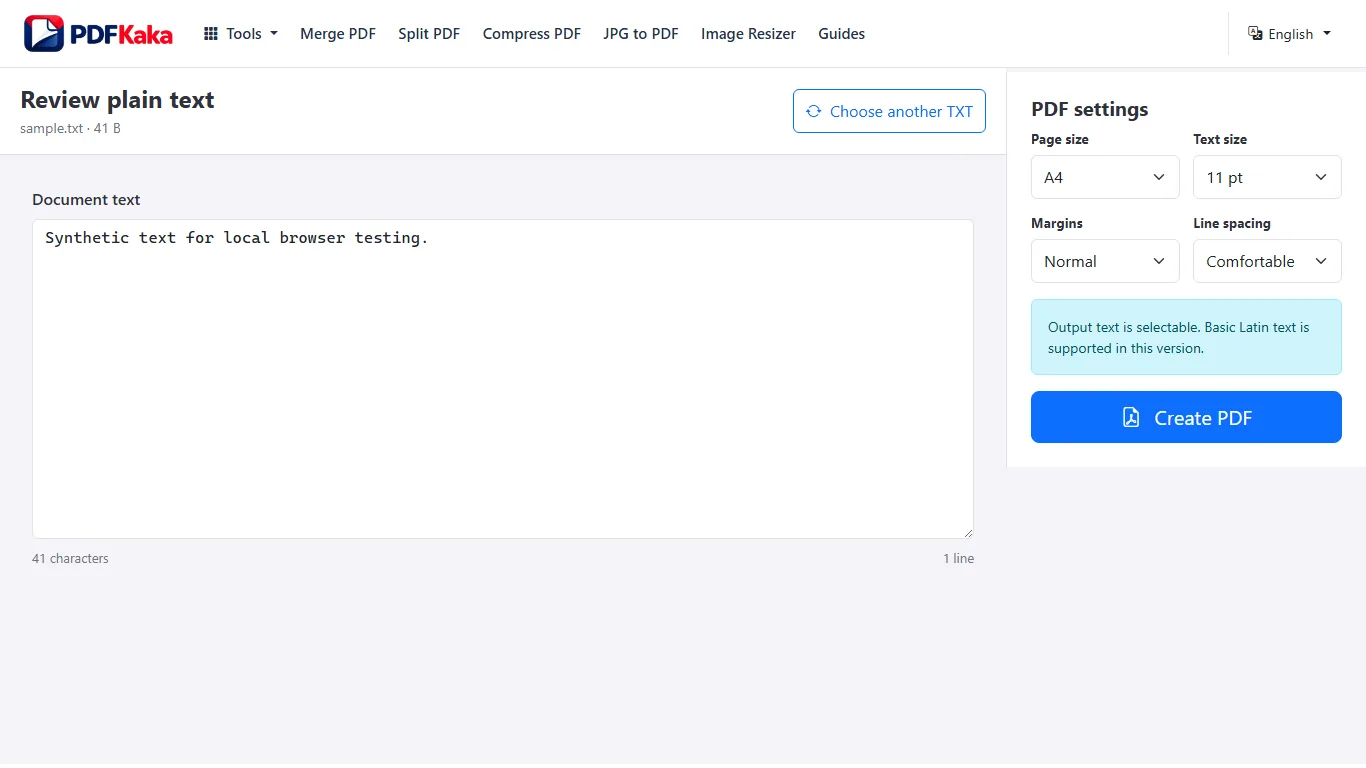
TXT to PDF paginates plain text using the paper size, margins, font size, and line spacing you choose. The result keeps text selectable and creates a stable document for printing, reviewing, or sharing without turning the text into screenshots.
- Create PDF pages from a TXT file. Choose a UTF-8 text file, review its content, adjust the page settings, and create a consistently paginated PDF.
- Keep plain text selectable. The generated PDF stores real text rather than page images, making simple notes, logs, and drafts easier to search and copy.
- Choose readable text spacing. Paper size, margins, font size, and line spacing determine how much content appears on each page. Very long lines wrap within the selected margins.
Review structure and formatting separately
TXT to PDF handles the documented conversion or placement, but fixed PDF geometry, flowing text, page breaks, fonts, and image dimensions do not always map one-to-one.
Prioritize the structure the destination actually needs. A visually similar page may not contain editable objects, while editable text may need manual layout repair.
- Check headings, paragraphs, lists, tables, and page boundaries.
- Compare fonts, line breaks, positions, and dimensions.
- Correct the destination file before publishing or submitting it.
Settings and limitations to check
Can I convert TXT to PDF online for free? Yes. Choose a supported plain-text file and create the PDF without registration.
Does TXT to PDF understand Markdown formatting? No. The input is treated as plain text; Markdown and rich-text styling are not interpreted.
Will every writing system display correctly? The current standard PDF font is intended for basic Latin characters. Review non-Latin or specialist characters before relying on the result.
- Use only the settings needed for the required result.
- Keep the source file available for comparison.
- Do not rely on an unsupported exact-size, fidelity, or security promise.
Review the completed file
Inspect lists, addresses, code-like text, blank lines, and paragraph boundaries in the output.
Open the downloaded result in a separate viewer, inspect important pages or details, and repeat the workflow with adjusted settings if the output is not suitable.
- Confirm the expected file type and page count.
- Check important text, images, order, and orientation.
- Share or submit only the reviewed copy.
Tools used in this workflow
Frequently asked questions
What should I prepare before following this workflow?
Keep meaningful plain-text line breaks while allowing long lines to wrap within the selected PDF margins.
How should I verify the result?
Inspect lists, addresses, code-like text, blank lines, and paragraph boundaries in the output.
Can I convert TXT to PDF online for free?
Yes. Choose a supported plain-text file and create the PDF without registration.
Does TXT to PDF understand Markdown formatting?
No. The input is treated as plain text; Markdown and rich-text styling are not interpreted.
Will every writing system display correctly?
The current standard PDF font is intended for basic Latin characters. Review non-Latin or specialist characters before relying on the result.
Do I need an account to use TXT to PDF?
No. Current PDFKaka tools work without registration or sign-in.
Are my files uploaded while I use TXT to PDF?
No. This working tool processes the selected files locally in the current browser session.