
HTML to PDF guides

How to convert an HTML file to PDF on a phone

Select a local HTML file from phone storage and create a PDF in a mobile browser without loading the original website.
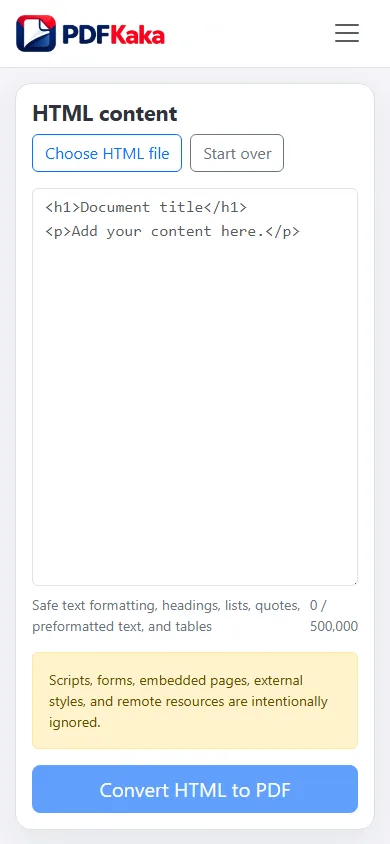
Open HTML to PDF

Reviewed by PDFKaka ·

How to convert an HTML file to PDF on a phone

What this workflow helps you do

A phone browser can run HTML to PDF without a separate desktop program. Device memory, the mobile file picker, camera permissions, and download handling matter more on a phone, so smaller batches are easier to verify.

Select a local HTML file from phone storage and create a PDF in a mobile browser without loading the original website.

Plan the task in HTML to PDF

Create a PDF from self-contained HTML while intentionally ignoring scripts, forms, embedded pages, and remote resources for a safer local conversion.

HTML to PDF turns supported HTML text or a local HTML file into a portable document. It is intentionally designed for safe, self-contained content rather than capturing an arbitrary live website, executing scripts, or downloading remote resources.

  1. Convert an HTML file or pasted HTML code. Choose a local file or paste supported markup, review the sanitized content, and create a PDF from headings, paragraphs, lists, links, and simple tables.
  2. Keep remote content out of the conversion. Scripts, forms, embedded pages, remote images, and external styles are ignored. This reduces unexpected network access and makes the conversion behaviour easier to understand.
  3. Use HTML to PDF for simple documents. Formatted notes, internal instructions, basic reports, and self-contained articles are suitable. Complex responsive layouts and browser-perfect website capture are outside the current tool's scope.

Complete the task reliably on a phone

The mobile file picker may show Photos, Files, Downloads, a camera option, or cloud-provider shortcuts depending on the device. Select only the sources required by HTML to PDF and return to the browser while processing finishes.

Large documents and high-resolution images use device memory. If the browser reloads or becomes unresponsive, keep the originals and retry with a smaller supported batch rather than repeatedly starting the same large job.

  1. Use a current browser and keep the tab active during processing.
  2. Save the result to Files or Downloads.
  3. Reopen the download outside the tool before sharing it.

Settings and limitations to check

Can I use this HTML to PDF converter online for free? Yes. Convert supported pasted HTML or a local HTML file without registration.

Can I enter a website URL and capture the full page? No. The tool does not fetch arbitrary websites. It converts safe, self-contained HTML supplied by you.

Will JavaScript and external CSS run in the PDF? No. Scripts and remote resources are deliberately excluded, and complex browser layouts may not be reproduced exactly.

  1. Use only the settings needed for the required result.
  2. Keep the source file available for comparison.
  3. Do not rely on an unsupported exact-size, fidelity, or security promise.

Review the completed file

Open the PDF on the phone and check long lines, tables, page breaks, and text size.

Open the downloaded result in a separate viewer, inspect important pages or details, and repeat the workflow with adjusted settings if the output is not suitable.

  1. Confirm the expected file type and page count.
  2. Check important text, images, order, and orientation.
  3. Share or submit only the reviewed copy.

Tools used in this workflow

Frequently asked questions

What should I prepare before following this workflow?

Select a local HTML file from phone storage and create a PDF in a mobile browser without loading the original website.

How should I verify the result?

Open the PDF on the phone and check long lines, tables, page breaks, and text size.

Can I use this HTML to PDF converter online for free?

Yes. Convert supported pasted HTML or a local HTML file without registration.

Can I enter a website URL and capture the full page?

No. The tool does not fetch arbitrary websites. It converts safe, self-contained HTML supplied by you.

Will JavaScript and external CSS run in the PDF?

No. Scripts and remote resources are deliberately excluded, and complex browser layouts may not be reproduced exactly.

Do I need an account to use HTML to PDF?

No. Current PDFKaka tools work without registration or sign-in.

Are my files uploaded while I use HTML to PDF?

No. This working tool processes the selected files locally in the current browser session.